Mathematical Oncology

Mathematical modelling predicts selective sweeps are restricted to early stages of tumour growth

Behind the paper

Written by Alexander Stein - March 04, 2026


Selective sweep probabilities in spatially expanding populations

Alexander Stein, Kate Bostock, Ramanarayanan Kizhuttil, Maciej Bak and Robert Noble

Read the paper

In most cancer types, one observes a handful of clonal driver mutations (present in all cells) and, depending on the sampling scheme, one or few subclonal driver mutations (present in only a subset of cells) [1, 2]. A natural and fundamental question to ask is when do driver mutations fixate, and when do they remain subclonal due to clonal interference? Because of clinical and experimental constraints, it remains difficult to answer this question directly from sequencing data. However, as we show in our new paper, one can tackle this question through tractable mathematical models and agent-based simulations of tumour growth.

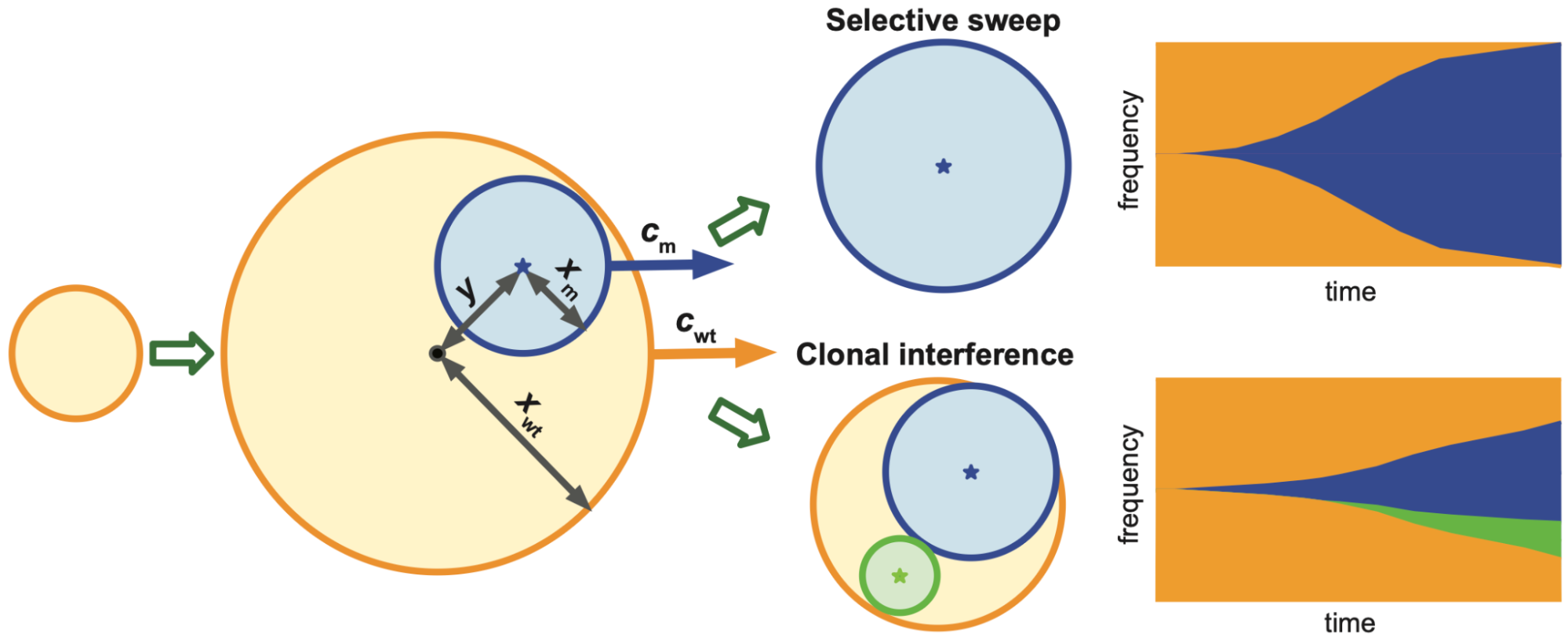
By investigating the timing and frequencies of selective sweeps across different mathematical models, we find that sweeps are rare except during early tumour growth. Once a tumour is in its final growth phase and is more than a cubic millimeter in volume, we predict that even extremely strong drivers are highly unlikely to become clonal and will instead contribute to genetic heterogeneity and possibly to parallel evolution.
figure
Figure 1: Illustration of spatial tumour expansion (not in scale) contrasting a successful selective sweep and clonal interference.

Beyond cancer research, our work fills in a gap in the theory of population genetics that has focused on investigating selective sweeps in constant-size populations [3, 4, 5], and complements studies of range expansions that have focused on the case where cells proliferate only at the population periphery [6, 7].

A mathematically tractable model of spatial tumour evolution

Most models of spatial tumour evolution are either deterministic partial differential equations or stochastic agent-based simulations. In our study, we instead used a semi-deterministic model with deterministic radial growth and stochastic mutations (akin to ref. [6]). The result is an inhomogeneous Poisson process that is relatively easy to analyse and yet yields valuable insights. Combining basic probability theory, integral calculus, and geometry, we derive probability densities for the time when the first mutant occurs, the location of the first mutant and the sweep probability.

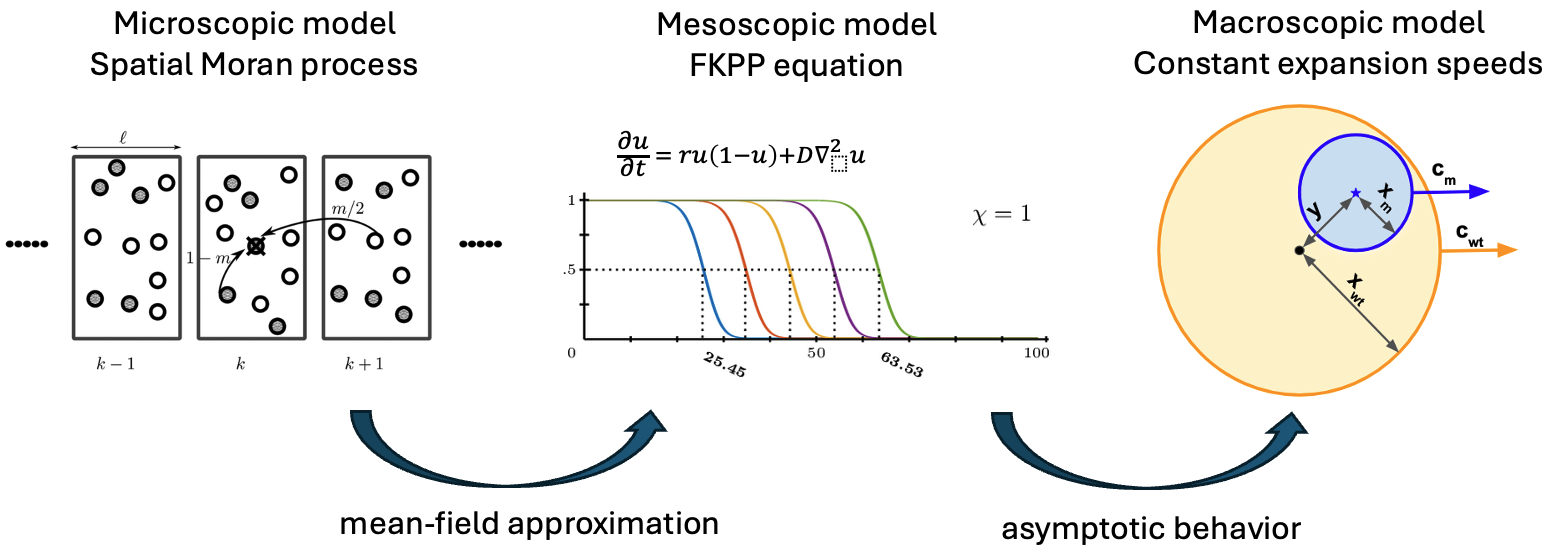
In the case of constant propagation speed, our semi-deterministic model can be understood as a counterpart of the fully stochastic spatial Moran process with mutations (see Figure 2). Formally, one can take a mean-field approximation of the spatial Moran process to obtain the Fisher Kolmogorov Pisconov Petruvsky (FKPP) equation. Taking the limiting behaviour of the FKPP equation, we have constant propagation speed. In this case, the tumour volume follows polynomial growth, and we find a simple approximation for the sweep probability that reads $$ Pr(sweep) = \left(1-\frac{c_{wt}}{c_{m}}\right)^d, $$ where $c_{wt}$ is the propagation speed of the wildtype clone, $c_{m}$ is the propagation speed of the mutant clone and $d$ is the spatial dimension with $d=3$ for solid tumours. The propagation speed itself can be related to the proliferation rates of the spatial Moran process (see eqn.(13) in our manuscript).

figure
Figure 2: From the spatial Moran process to the FKPP equation to deterministic radial expansion. The left panel was taken from ref. [8] and the middle panel was taken from ref. [9].

Independence of the mutation rate

Interestingly, we find that the sweep probability is independent of the mutation rate $\mu$. This is the case not only for the approximate solution but also for the exact solution of our main model (have a look at SI Text Section 4 for a neat scaling analysis) and the case where proliferation is bound to the periphery. In the case of exponentially growing populations, we find a scaling of the form $Pr(sweep) ~\mu e^{-const. \times \mu}$ that is increasing for increasing $\mu$ given typical parameter values. This contrasts with studies of selective sweeps in constant populations, in which the sweep probability is highly sensitive to perturbations in the mutation rate and decreases with increasing $\mu$ according to $Pr(sweep) ~ e^{-const. \times \mu}$. Intuitively, this phenomenon may be understood by two opposing effects: First, an increased mutation rate leads to earlier arrival of the first (sweeping) mutant. This way, there is less wildtype population to sweep through, which increases the sweep probability. Second, an increased mutation rate leads to higher chances for interfering clones to arrive, which decreases the sweep probability. The first effect applies only for expanding populations, but not to constant populations that have by assumption always the same population size.

Investigating successive mutation and random mutation effects

Using the demon agent-based modelling framework [10] within the warlock computational workflow [11], we ran and analysed 64,000 agent-based simulations resembling the two-dimensional spatial Moran process with mutations. From those, 24,000 were used to validate our analytic results. With the remaining 48,000 simulations, we extended our considerations to successive mutations and random mutation effects.

If mutation effects are random, but we allow at most one driver mutation in each cell, we find sweep probabilities similar to those when mutation effects are fixed (see black triangles and red dots in the left panel of Figure 3). If we allow successive driver mutations, sweep probabilities are elevated (cyan square in the left panel of Figure 3), yet we would expect sweeps to be completed by the time the tumour reaches typical detection sizes (right panel of Figure 3).

figure
Figure 3: Sweep probabilities and population radii at sweep completion

Final words

In our paper, we illustrate the power of mathematical modelling to study early tumour evolution, in which data-driven analyses are limited by clinical and experimental constraints. Our study showcases inhomogeneous Poisson process as a valuable framework to study spatial tumour evolution, from which we obtained a surprisingly simple expression for the sweep probability that may be used as a rule of thumb in future studies. Considering alternative growth laws and thorough integration of the literature, we increased the generality of our results. Lastly, we validated and extended our results to more complex scenarios using agent-based simulations.

This work has started from an idea in 2017. If you are curious about the journey of the project from the idea to the final publication, have a look at this link. We also created some art work that you can find here.

References

  1. ICGC/TCGA Pan-Cancer Analysis of Whole Genomes Consortium Pan-cancer analysis of whole genomes. Nature 578, 82–93 (2020). https://doi.org/10.1038/s41586-020-1969-6
  2. Dentro, S. C. et al. Characterizing genetic intra-tumor heterogeneity across 2,658 human cancer genomes. Cell 184, 2239–2254 (2021). https://doi.org/10.1016/j.cell.2021.03.009
  3. Gerrish, P. J. & Lenski, R. E. The fate of competing beneficial mutations in an asexual population. Genetica 102, 127–144 (1998). https://doi.org/10.1023/A:1017067816551
  4. Martens, E. A., Kostadinov, R., Maley, C. C. & Hallatschek, O. Spatial structure increases the waiting time for cancer. N. J. Phys. 13, 115014 (2011). https://doi.org/10.1088/1367-2630/13/11/115014
  5. Ralph, P. & Coop, G. Parallel adaptation: one or many waves of advance of an advantageous allele? Genetics 186, 647–668 (2010). https://doi.org/10.1534/genetics.110.119594
  6. Antal, T., Krapivsky, P. L. & Nowak, M. A. Spatial evolution of tumors with successive driver mutations. Phys. Rev. E 92, 022705 (2015). https://doi.org/10.1103/PhysRevE.92.022705
  7. Fusco, D., Gralka, M., Kayser, J., Anderson, A. & Hallatschek, O. Excess of mutational jackpot events in expanding populations revealed by spatial Luria–Delbrück experiments. Nat. Commun. 7, 12760 (2016). https://doi.org/10.1038/ncomms12760
  8. Houchmandzadeh, B. & Vallade, M. Fisher waves: an individual-based stochastic model. Phys. Rev. E 96, 012414 (2017). https://doi.org/10.1103/PhysRevE.96.012414
  9. Henderson, C. & Rezek, M. Traveling waves for the Keller-Segel-FKPP equation with strong chemotaxis. Journal of Differential Equations, 379, 497-523 (2024). https://doi.org/10.1016/j.jde.2023.10.030
  10. Noble, R. Demon: deme-based oncology model. https://github.com/robjohnnoble/demonmodel, (2023).
  11. Bak, M., Colyer, B., Manojlović, V. and Noble, R. Warlock: an automated computational workflow for simulating spatially structured tumour evolution. Preprint at https://doi.org/10.48550/arXiv.2301.07808 (2023).
← Previous Post