Click the image below to view the full size version of this
cover.
Created by: Sarah Groves
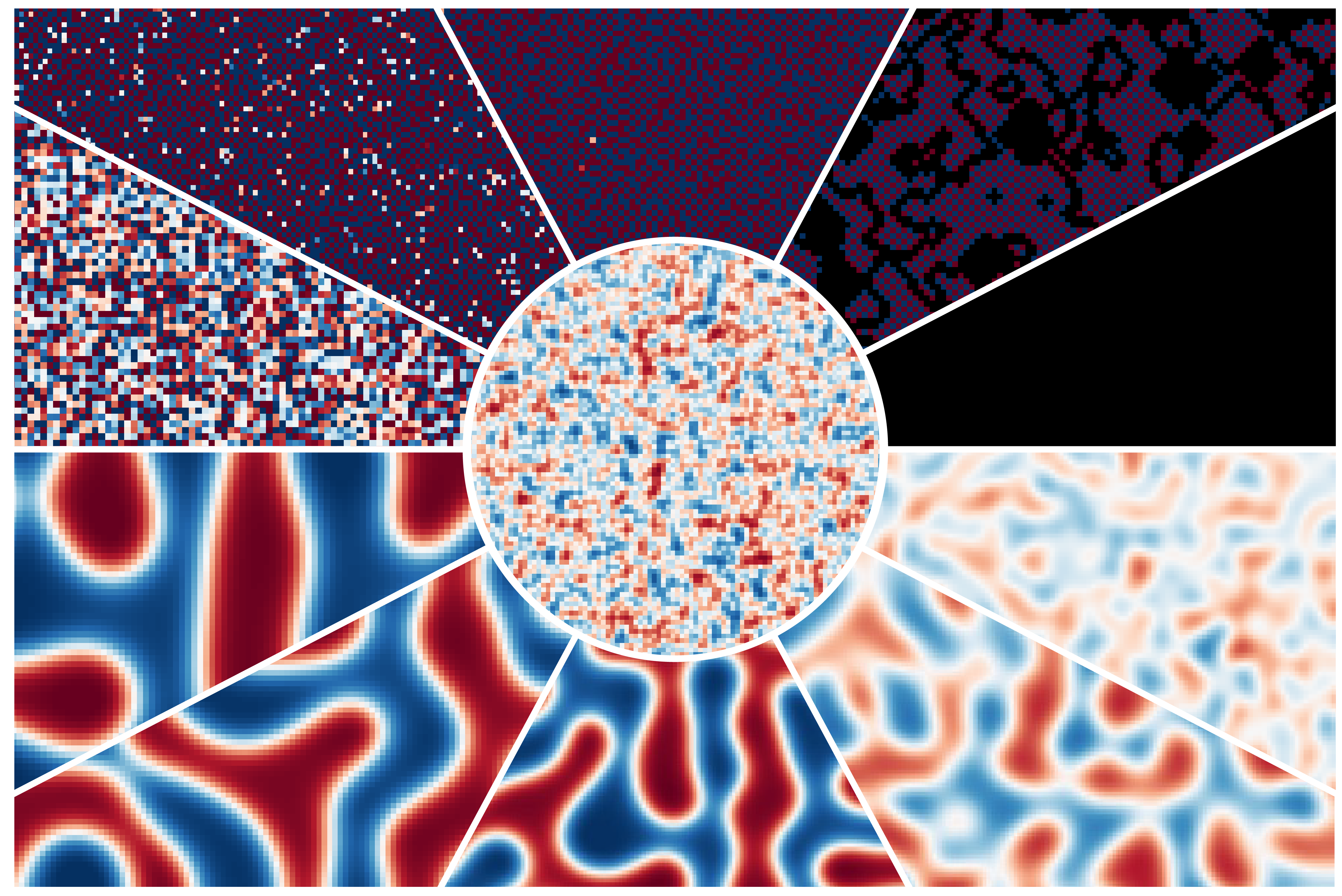
Issue 341: Biological condensates are protein-filled liquid droplets that form without a membrane. There are many examples of condensates in cells, and the formation or lack of formation of condensates has been implicated in cancer progression. In particular, a mitotic protein complex called CPC, which regulates the spindle assembly checkpoint and ensures proper chromosomal segregation, forms condensates and is dysregulated in cancer, leading to severe aneuploidy in some cases like triple negative breast cancer. To model condensate formation, we encoded numerical methods that solve the Cahn Hilliard equation, which has been around for quite some time but has not been computationally accessible to computational biologists. This artwork is showing the results of simulating droplet formation using the numerical methods we developed as opposed to a simpler numerical solver, the finite difference method. The initial conditions are shown in the center of the sun, and the top segments (from left to right) show the finite difference solution-black represents NaNs arising in the simulation as it quickly breaks down. The bottom segments (from right to left) show the true dynamics determined by our solvers as droplets in red begin to form.
© 2026 - The Mathematical Oncology Blog