Click the image below to view the full size version of this
cover.
Created by: Robert Noble
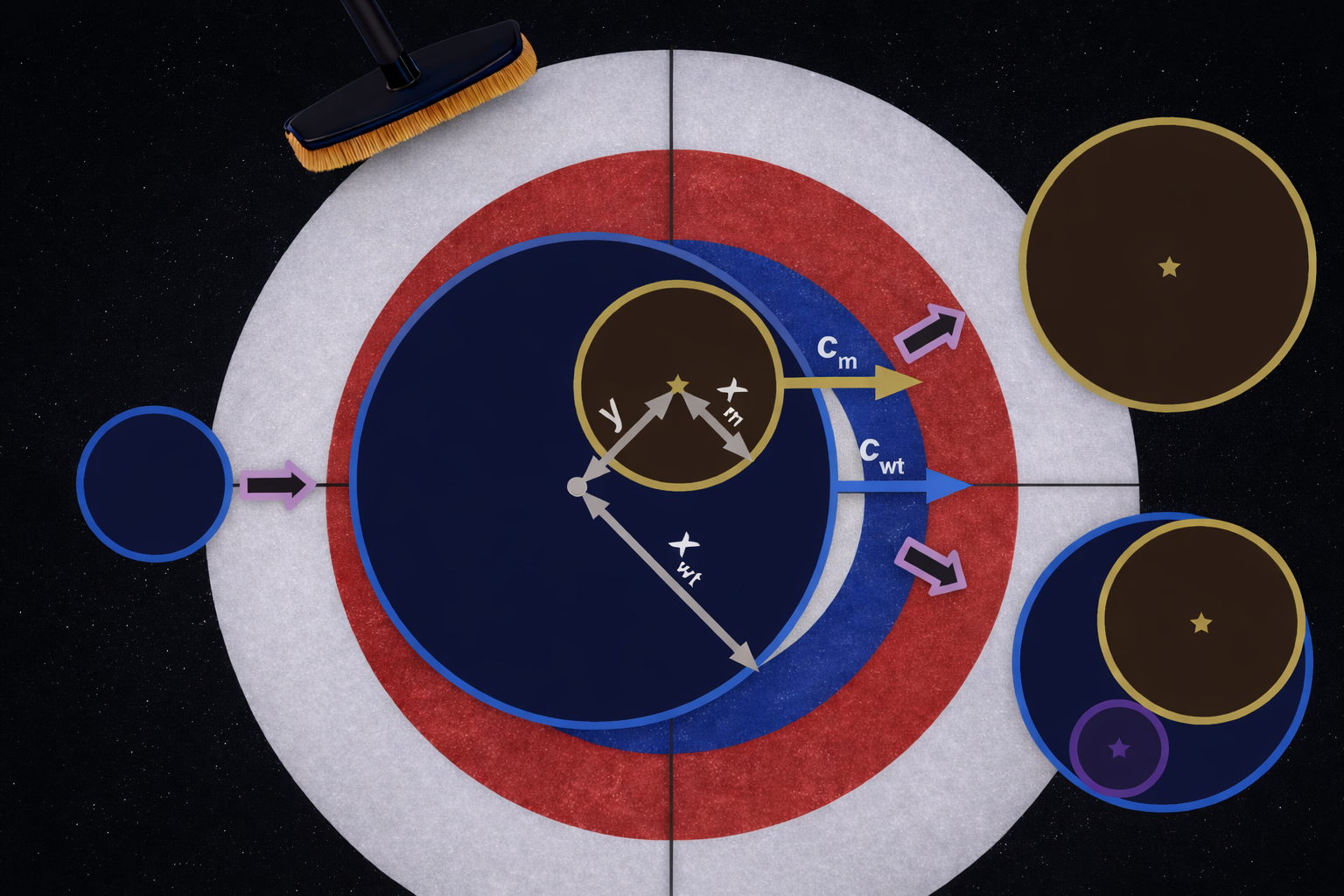
Issue 362: Success in a sport like curling depends not only on how much stronger you are than your competitors but also very much on luck. Likewise in biological evolution. The multistepgenetic model of cancer development posits that tumours overcome physiological constraints and become more aggressive by successively acquiring driver mutations. If a fitter mutant cell line age can disperse within a tumour then, in principle, it might eventually spread and outcompete all other lineages, thus achieving a selective sweep (upper right in the image). Alternatively, another mutant of similar fitness might arise and block the advance of the first mutant via clonal interference (lower right). To investigate which scenario is most likely, we analysed a macroscopic, stochastic model to obtain simple expressions for sweep probabilities in one, two and three dimensions. We ran extensive agent-based simulations to test the robustness of these results,which are equally applicable to otherexpanding, evolving populations such as bacterial colonies andinvasive species. A post on the Mathematical Oncology Blog explains more about our study and a Behind the Paper post tells the story of how this project evolved from master’s thesis to published paper. The artwork was created assisted by ChatGPT.
© 2026 - The Mathematical Oncology Blog