
Click the image below to view the full size version of this
cover.
Created by: Christopher Boniface
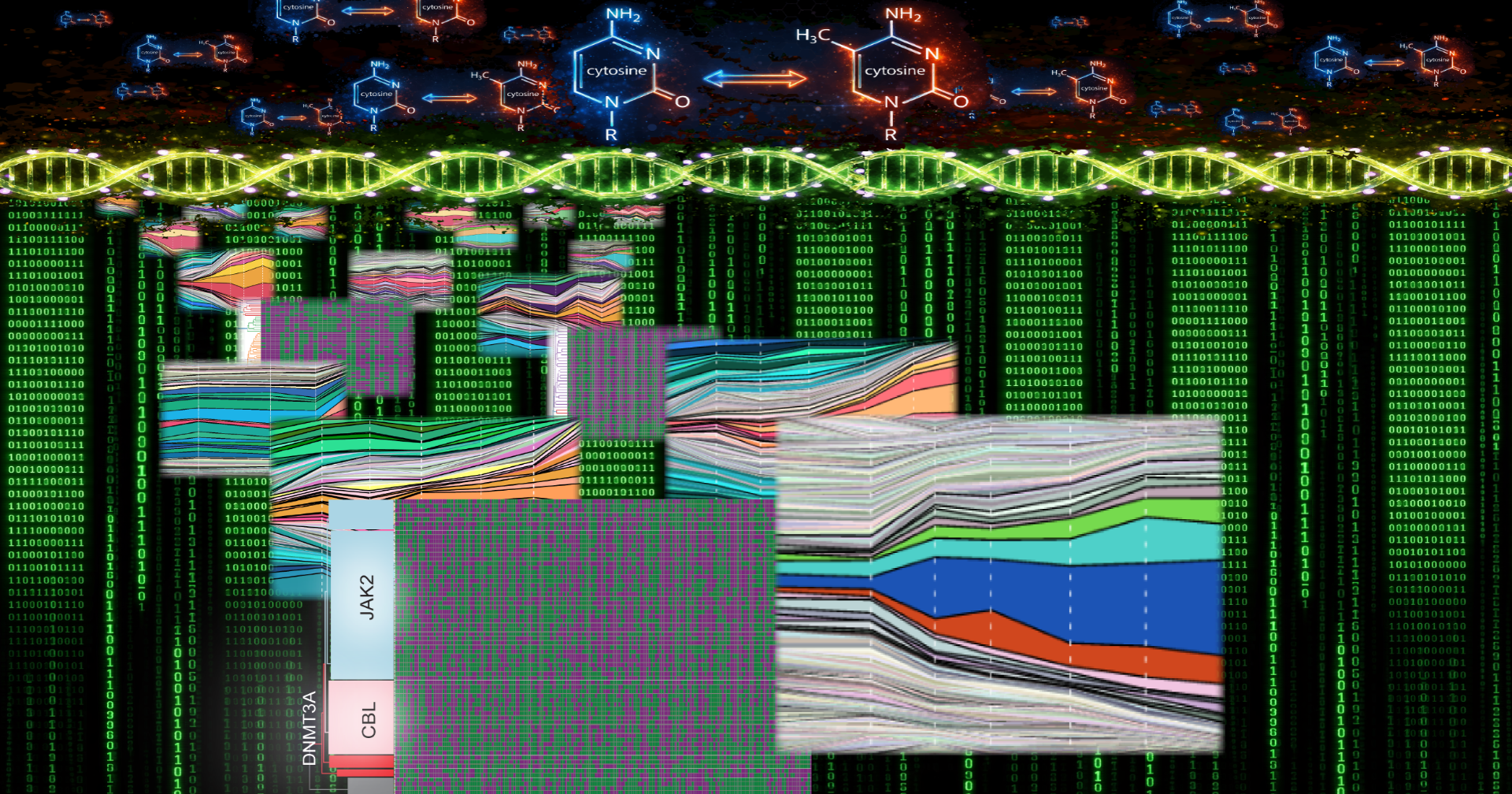
Issue 369: Recent work has leveraged stochastic DNA methylation at “fluctuating” CpG dinucleotides (fCpGs) to detect clonal expansions and infer evolutionary dynamics in bulk cell populations. However, the genomic dispersion of these sites has limited their utility for high-resolution lineage reconstruction. We have recently identified dense, contiguous regions of fCpGs within the protocadherin (PCDH) gene cluster that can be captured on single paired-end reads, enabling compact, information-rich methylation barcodes (https://doi.org/10.64898/2026.02.23.707349). Using these barcodes, we trace clonal expansions years prior to acute myeloid leukemia diagnosis and uncover evidence of “cryptic” drivers not detectable through conventional mutational profiling. Across serial samples, barcode frequencies quantitatively recapitulate clonal cell fractions and growth kinetics. We further extend this framework using long-read sequencing to phase hundreds of CpGs into ultra-long barcodes, enabling reconstruction of complex clonal histories from a single bulk blood sample. This substantially increases phylogenetic resolution without requiring single-cell approaches. Importantly, we demonstrate that this strategy generalizes beyond hematopoiesis and is applicable to solid tumors. The accompanying image illustrates the decoding of PCDH methylation barcodes from bulk sequencing into binary strings, which are then used to reconstruct clonal dynamics. River plots visualize temporal clonal expansions, while heatmaps of long-read barcodes reveal high-dimensional clonal architecture within individual samples.
© 2026 - The Mathematical Oncology Blog