Click the image below to view the full size version of this
cover.
Created by: Kit Gallagher, Maximilian Strobl, Sandy Anderson
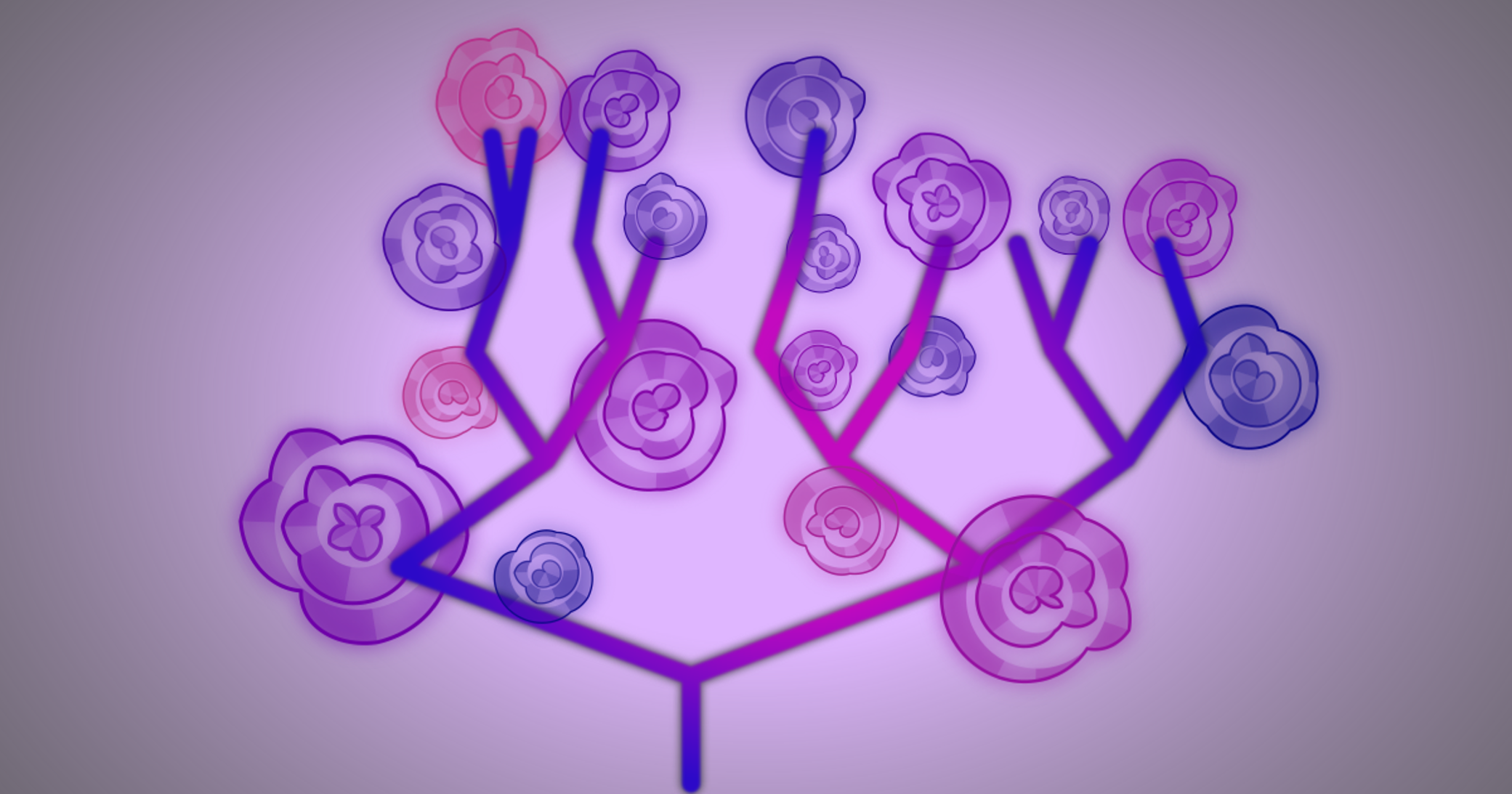
Issue 379: Adaptive Therapy has been developed as an alternative treatment scheduling paradigm to continuous therapy, applying breaks in treatment to resensitize the tumor to the applied therapeutic, and hence delay patient progression. Previous adaptive approaches have employed a 'one size fits all' approach to scheduling these breaks, applying the same algorithm to all patients despite their widely different tumor dynamics. This heterogeneity inspired the cover image, where each circular 'flower' motif depicts possible treatment responses for a single patient. The tumor response is wrapped into a circle, with the radius corresponding to the tumor size, and the shading corresponding to the drug treatment. Each flower represents three possible outcomes, with the outermost circle depicting the best outcome. These flowers decorate a spring-time tree, formed by considering the possible treatment decisions at each point in a patient's history, where each branch represents a series of treatment periods or drug holidays, and forks denote a new treatment possibility. By navigating these decisions optimally, supported by predictive biomarkers, the patient's time to progression is extended compared to conventional strategies.
© 2026 - The Mathematical Oncology Blog