Click the image below to view the full size version of this
cover.
Created by: Hui Li
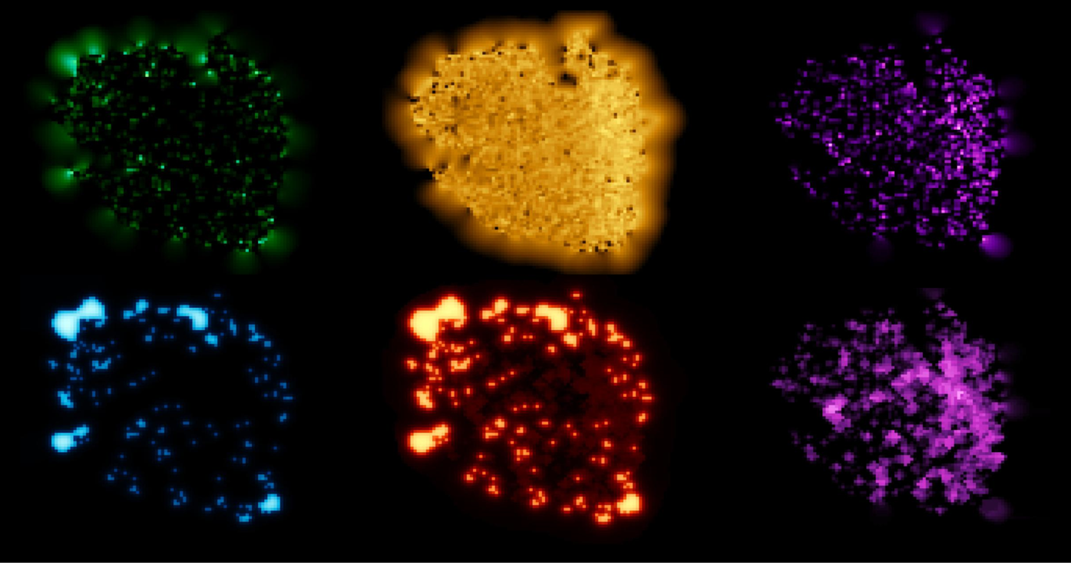
Issue 376: Tumors are not uniform masses; they contain cells with vastly different phenotypes, a feature that complicates treatment and drives drug resistance. This artwork, adapted from our spatial data‑informed nonlocal reaction‑diffusion model, shows how tumor cells evolve across space in response to oxygen availability. The upper panels depict initial patient data from a glioblastoma sample: blood vessel locations, tumor cell density, and the mean phenotypic state (based on HIF gene expression). The lower panels reveal the model’s steady‑state predictions: oxygen concentration, local cell density, and the resulting mean phenotypic state. Near blood vessels, oxygen supply is high, favoring aerobic phenotypes (low HIF); far from vessels, hypoxia dominates, pushing cells toward a high‑HIF state. By integrating spatial transcriptomics into a rigorous mathematical framework, our work uncovers how vascular clustering and tumor‑vessel proximity shape long‑term phenotypic heterogeneity. Such model‑data integration offers a powerful lens to predict tumor evolution and design spatially‑adaptive therapies.
© 2026 - The Mathematical Oncology Blog