A Year in Mathematical Oncology
2025 Blog Recap
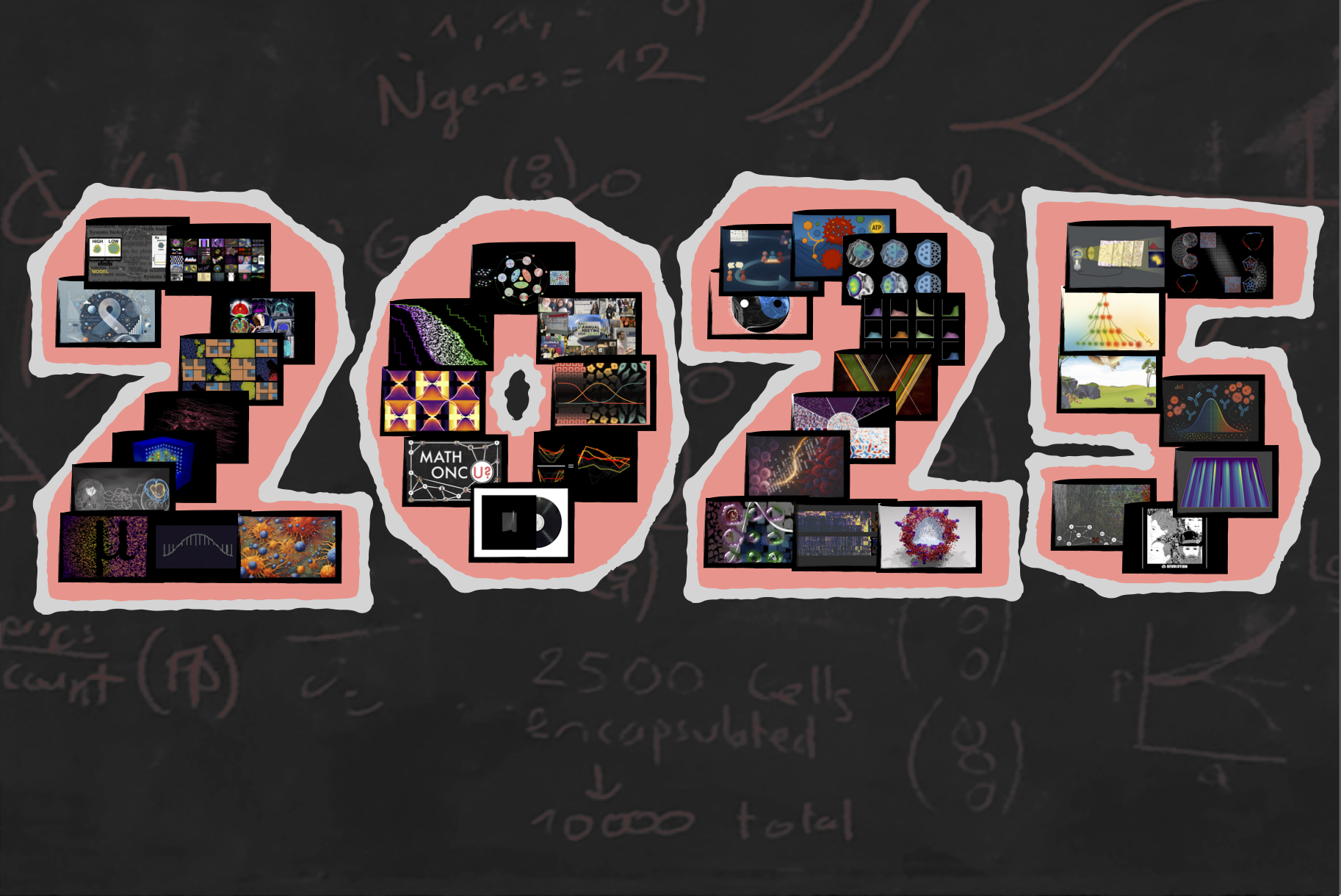
As 2026 starts, I always like to take advantage of my role as editor of this blog to continue with the annual tradition: stepping back to reflect on the journey our community has taken over the past year.
This blog has continued to grow as a venue for dialogue in the mathematical and computational oncology community. In 2025, we were privileged to host contributions from mathematical oncologists in at least 10 countries (including the USA, Canada, France, Germany, Italy, Spain, Norway, Denmark, Switzerland, and the UK),. from specialized cancer centers like Moffitt and City of Hope to national research institutes like Inria and Inserm, the diversity of institutions represented highlights the fact that mathematical oncology is a global effort. We owe a massive debt of gratitude to the authors, from tenured professors and clinicians to even high school students, who shared their "Behind the Paper" insights and workshop recaps with us this year (shoutout to the BIRS workshop whose participants submitted a number of posts, clearly a productive place to work!).
Ideally, the posts we receive represent what this community is thinking about and working on. Based on the year's submissions, I think that there are 3 themes that defined it: machine learning in mathonco, treatment optimization and…well, others.
1. The Era of Mechanistic Learning
AI has been making headlines everywhere, and it has for a little while now. The most recent podcast of the SMB has SMB’s president Reinhard Laubenbacher discuss the challenges and opportunities that new AI tools brings to the field. In my mind, the challenge for mathematical oncologists is that the predictive power these models provide often comes at the expense of understanding the mechanisms that drive cancer. Being able to explore different biological hypotheses is thus one of the most prominent themes in 2025 was the integration of machine learning (ML) and artificial intelligence (AI) with mechanistic modeling, a synergy our contributors have termed "mechanistic learning". This approach moves beyond black-box AI by joining both biological and physical constraints directly into neural network architectures.
- BIRS Recap: Biophysically-Constrained GBM Predictions via Deep-Learning Integrating Structural SINDY with Mechanistic Filters: Explores using "mechanistic filters" to ensure AI predictions of tumor recurrence respect brain tissue morphology.
- Learning Dynamics with Neural Networks: Reviews how Neural DEs, UDEs, and UPINNs can handle the sparse, noisy data typical of clinical settings.
- Generative AI & Mathematical Oncology: Discusses how genAI can synthesize missing medical images to enrich the longitudinal datasets needed for mechanistic models.
- BIRS Recap: Machine learning for model parameterization: Focuses on hybrid and hierarchical modeling to account for patient variability.
- The Future of Mathematical Oncology in the Age of AI: A consensus opinion from the Siracusa conference on the coming shift toward "Agentic AI" workflows.
2. Evolutionary Steering and Treatment Optimization
Unsurprisingly, getting new and better treatments has always been a major goal for mathematical oncologists and the posts this year reflect that. And the way these posters do it takes full advantage of the power of mathematical and computational models. Our community is increasingly focused on using predictive models to improve treatment, often anticipating evolutionary dynamics. This involves using models to find the perfect balance between killing the tumor bulk and managing the emergence of drug resistance. Posts covering this included:
- Optimal dosing of anti-cancer drug treatment under drug-induced plasticity: Introduces models that account for non-genetic drug tolerance, suggesting distinct transient and equilibrium dosing phases.
- Drug-induced proliferation curves preserve convexity: Details the concept of Evolutionary Antifragile Therapy, where uneven dosing schedules exploit the convexity of dose-response curves.
- BIRS Recap: INSITE: Lays out a pipeline for in silico (virtual) clinical trials to identify optimal patient subgroups and schedules.
- Mechanistic learning in action at COMPO: Highlights the success of model-driven adaptive scheduling, which doubled median survival in breast cancer patients.
3. Democratization, Education, and Outreach
I have grouped here posts that, while not strictly related, show that a strong mathematical oncology community is one that includes everyone from high schoolers to experimental collaborators to bioinformaticians.
- Use this cell grammar to simplify systems biology modeling: Introduces a human-interpretable grammar for the PhysiCell platform, allowing researchers to build complex agent-based models using simple statements instead of C++ code.
- High School Mathematical Oncology: A student-led initiative featuring interviews with field leaders and foundational resources for younger researchers.
- What is systems biology, and how is it related to mathematical oncology?: A video project designed to introduce clinicians to the utility of systems approaches in oncology.
- Fields Thematic Program in Mathematical Oncology: A recap of six months of exploration in Toronto, reflecting on 25 years of the field's history and its reciprocal relationship with pure mathematics.
- Cancer classification from Copy Number Segments using CNSistent and PyTorch: A technical tutorial for the community on processing and classifying genomic data with high accuracy.
To say that 2025 was eventful would be an understatement. Factors that significantly influence both our daily and long-term work, factors rarely discussed on this blog have been particularly prominent. For example, here in the USA, funding uncertainty is a pressing concern (and that is only if your institution has not been targeted by the administration). On a different note, the NIH seems to be de-emphasizing the use of animal models which could make parameterization/calibration/validation more difficult but also goes to show the increasing importance of mathematical and computational models in cancer research going forward.
In 2025, we have seen the field continue to move towards more integrated, bigger, more data-driven approaches that require bigger and more interdisciplinary teams and that aim to find more ways to change treatment in the clinic. Whether it is using grammar to model cell behavior or the equations of drug resistance, this community is mapping the complexities of the disease embracing a complexity that was once purely theoretical. We look forward to seeing what you all build in 2026.
© 2026 - The Mathematical Oncology Blog